
Village Halls Retrofit Fund
Funding

Greener Peebles run a thriving community garden, with 2 weekly volunteer sessions and activities on food growing, horticulture, biodiversity, and skill sharing. Our sessions are open to all ages and abilities, we work with a wide range of local organisations, welcoming groups to visit and take part in our activities. Our garden features a variety of food growing spaces, including herb garden, polycarbonate tunnel, fruit trees, and plots for lease. We have a yurt with a wood-burner stove which supports us to run our sessions all year round. For more information, please contact [email protected] or visit Greener Peebles website or Facebook page.
Our ambition is to support local people to nurture and enjoy the outdoors, learn skills and connect with others. We aim to empower beneficiaries to feel good and reach their potential.
Funding from CMHW has been a great boost to our organisations ability to deliver our mission. CMHW has supported our staffed roles to deliver garden activities and bring an ongoing focus on wellbeing and mental health topic to the ongoing elements of garden sessions. We have created and delivered a programme of Wellbeing Skill Shares, and reached out to collaborate with more organisations, specifically to include more individuals identified by CMHW as priority groups, widening our reach in the local community.
Gardening is an inherently therapeutic activity. People benefits from spending time in nature, making new friends, learning new skills and giving back to their community.
Survey data collated February 2025 from our beneficiaries:
Since participating in Greener Peebles activities, I feel…
Our beneficiaries say:
“Greener Peebles is the one place where I feel relaxed. There’s a feeling of serenity. safe, calm, peaceful”
“I find the Community garden a joyful place. I love being there even if just going to tend to my raised bed between sessions with others. Lovely interactions with all age groups & abilities. I find learning new skills is inspiring”
“My mental health has improved so much. Having space and time to connect to nature with other members of the community is so special. I’ve also become more adventurous with food (specifically vegetables) and find myself eating a wider variety of seasonal veg.”
“If I’ve been feeling a bit down, I always feel more positive after a session in the community garden. It feels good to volunteer and to take home a harvest of fresh, locally grown fruit and vegetables”
“Going to the garden always makes me feel better. A warm welcome, smiling faces, and working outdoors with others all lift my mood. Thank you for all the wonderful opportunities the community garden offers”
“Since I’ve been at Greener Peebles, I feel lighter. Working outdoors with new friends is very beneficial for me. It energizes me for the whole day, regardless of the weather in the morning.”
“It’s really helped me rethink my connection to nature and to food. It’s also a place of acceptance and gentleness, where I always feel welcome by the team and other gardeners – it’s a haven of peace.”
“I first came to the Garden about 5 years ago. Over the years I have had mental and physical health problems and it can be helpful to talk with other volunteers and listen to their stories. It is a way to make new friends. Occasionally I have had to miss going for weeks or even months but I always feel welcomed back. The social events every few months are very enjoyable with food provided by Food Punks or the Food Foundation both charities which support people with learning and mental health difficulties. I have benefitted from skill shares and have even lead some myself. Because it is open 24/7 I am able to take friends and family to visit at any time. It is amazing to watch the toddlers enjoying the garden during the Grow Kids sessions. They explore the Garden with such confidence.”
Joining the community garden as a volunteer is a simple process. Garden volunteers do not require any experience, we welcome complete beginners and share our knowledge. There is no minimum commitment, we welcome people to drop-in to our sessions so people can be involved at their own pace.
For people who want like to take on a role with more responsibility, we have volunteer Teams, which are focused around a specific tasks for people to take on in the community garden. These can be done during sessions, or in own time, with family and friends, for example watering plants, to maintenance.
Our future plans include creating a “Volunteer Leader” role, so people can progress their volunteering experience.
As we work with increasing numbers of volunteers who have experience of mental health issues, we are mindful and considerate of our way of working with people, to be supportive and present.
Our work with CMHW has enabled us to provide training opportunities including;
CMHW has enabled us to bring the theme of wellbeing as a focus for our activities within the community garden. We have run our thriving, intergenerational garden, teaching people how to grow food, and enhance biodiversity – nature based activities which promote health living and feeling good. We know that joining in with our activities has therapeutic benefits, and our aim with CMHW was to help people to feel more comfortable to have discussions about mental health, so people can support each other and share self-care and experiences.
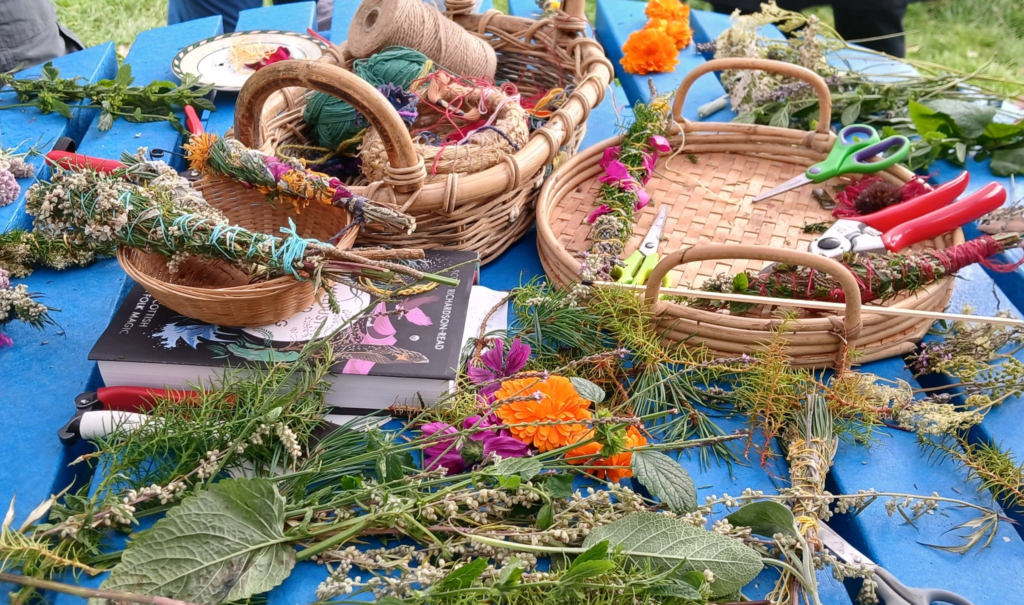
In addition to providing our gardening activities, we developed a programme of monthly Wellbeing Skill Shares based on feedback from our volunteers. We have held discursive sessions on topics such as Sleep, Music, Mental Health Conversations, Food and Mood, Exercise, Positive Psychology, Resilience and Breathing and also practical sessions including Gentle Exercise, Mindfulness in the Garden, Art in the Garden, and Crafting with Natural Materials.
Feedback from participants always guides what topics we chose next. Unsurprisingly, popular topics are Crafting with Natural Materials, including Willow Weaving, Herbal Sachets, Festive Wreaths and Willow Stars as these combine the great strengths of our project – being outdoors, growing food, herbs and flowers, and using these materials from our garden, to create something together.
We have learned how well we respond to slowing down, sitting together and doing something with our hands. Engaging with sensory materials and creating together is vital for people’s wellbeing and self-care, and we are delighted to have Wellbeing Skill Shares added to our regular activities. It is something different to what we usually offer week on week, and yet strongly aligns with our strengths of being outdoors, nature based, learning skills, and connecting with others. It has been an ideal addition to our core work, and we are grateful for CMHW for making this possible.
Yes, this project has enabled us to strengthen connections with local groups.
We have increased our beneficiary numbers and are working with more individuals from the groups identified by the CMHW priority aims.
We already work on a regular basis with other local organisations and have established partnerships. Support from CMHW has enabled us to reach out to new groups, to introduce what we do and invite groups to our events and activities, often with a specific focus to meet the needs and interests of particular groups. This has enabled us to build relationships, and adapt our garden as a space were everyone is welcomed, and has something which appeals to them.
Having support from CMHW has had a positive impact. As described above, it has supported our core work, enabled us to reach new groups and individuals, support our volunteers, and enabled us to review and improve our practices. These are all critical to our ongoing success.
Our future plans are to sustain our popular activity programme, and continue building on what we have learnt to grow our garden, and our people.
The process of applying for funding and reporting on our project has been straightforward and overall this has been good.
As with any feedback on funding processes, we are supportive of the recommendations by SCVO who have very well articulated the needs, and ideal funding model required to support the third sector to succeed long term; https://scvo.scot/policy/fair-funding-procurement/fair-funding/what-is-fair-funding
This project has been a great success and we are delighted on what we have achieved. We have refined our activities to focus on supporting wellbeing and reduce stigma around mental health topics.
Now we are actively working with increased numbers of individuals who have higher support needs due to mental health issues, whom we have recruited with the support and encouragement of this grant; what we really need to achieve our goals is confidence that funding for our project will continue. One of the challenges of third sector work is it is dependence on short term funding.
We would like to see long term funding for community projects like ours, whom have a strong track record of support peoples mental health and wellbeing.


